Richard Yan

Richard Yan

Europe

Test BIO

The Stamp and the Meter
Richard Yan

The Stamp and the Meter

Where the Rule Binds Aug 10 · 10 min read

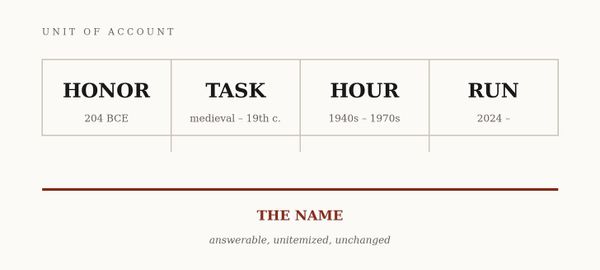
The billable hour was never a measurement. It was a grammar, and the machine is only changing its units. AI was supposed to kill the billable hour. The argument writes itself. When a research memo that took thirty associate hours takes ninety minutes of machine time, billing by the hour becomes either absurd or dishonest. Absurd if the firm bills ninety minutes for work it once sold for thirty hours. Dishonest if it bills thirty hours anyway. So the hour must die, and firms must flee to flat fe

· 10 min read
Part II: The Window
Richard Yan

Part II: The Window

Where the Rule Binds Aug 03 · 10 min read

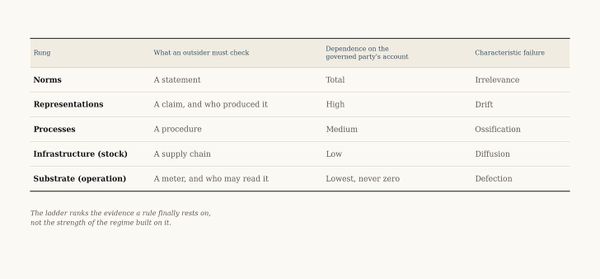
Part I ranked governance proposals by the object they bind to. This one asks how long that object stays adequate. Part I built a method. Every governance proposal finally rests on something an outsider has to check: a statement, a claim, a procedure, a supply chain, a measured physical event. Rank proposals by that object and they sort. Anthropic’s Responsible Scaling Policy is scaffolding at the representation rung. Plan A has the stronger architecture and the harder clock. This part asks the

· 10 min read
Part I: The Enforcement Ladder
Richard Yan

Part I: The Enforcement Ladder

Where the Rule Binds Jul 28 · 14 min read

Anthropic’s Responsible Scaling Policy and the AI Futures Project’s Plan A are not rival answers to one question. They bind to different objects, cost different amounts to build, and break in different places. Two governance proposals arrived this year. Anthropic has revised its Responsible Scaling Policy four times since the February rewrite. The AI Futures Project published AI 2040: Plan A, a recommendation rather than a forecast: a US–China agreement in 2029, total research transparency, ma

· 14 min read
The Wrong Ancestor
Richard Yan

The Wrong Ancestor

AI Has Ancestors Series Jul 21 · 10 min read

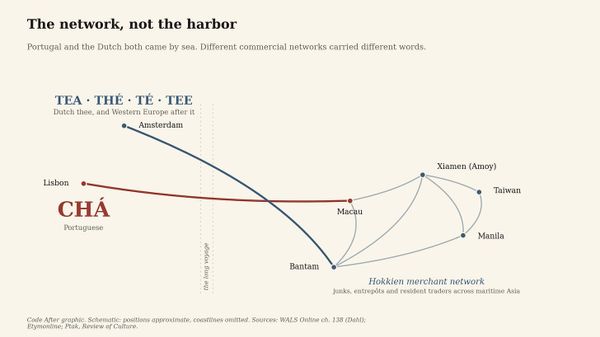
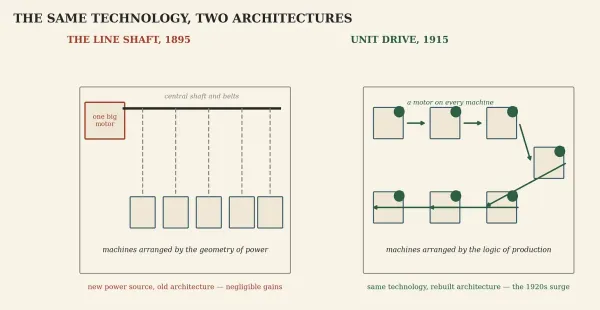
An essay in the AI Has Ancestors series. AI is not the next internet. It is the next electricity — a general-purpose production technology whose gains arrive only when organizations stop being designed around the scarcity it has begun to remove. This series has argued that AI has ancestors: writing, the alphabet, the printing press, the digital wire — the family of encoding technologies, of which AI is the fifth member and the first to perform thought rather than work on its record. That is th

· 10 min read
Chasing the Tails
Richard Yan

Chasing the Tails

AI Has Ancestors Series Jul 13 · 7 min read

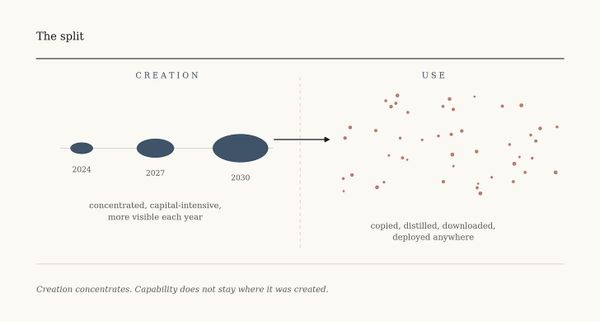
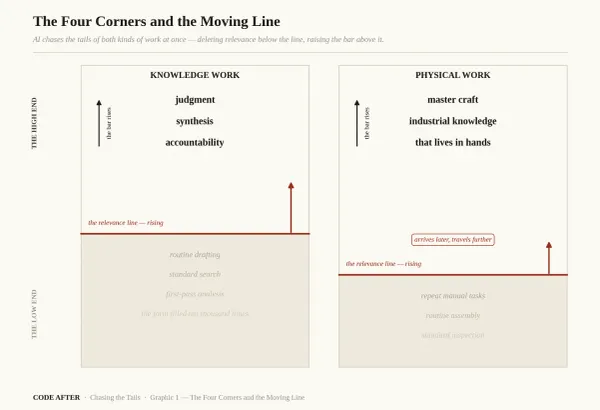
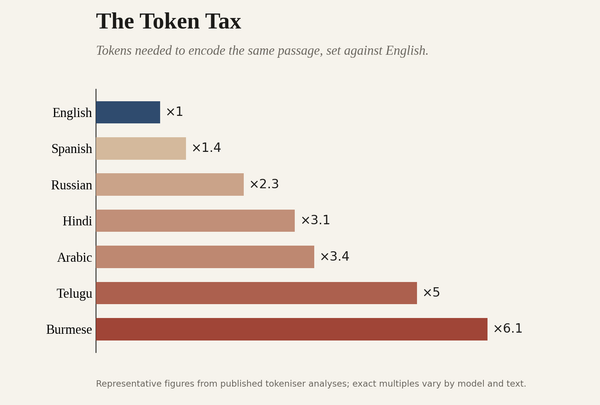
AI is reshaping work twice — once inside every workplace, and once across the map. The first everyone argues about. The second almost no one is governing. The standard frame says AI takes jobs. The frame is wrong in a way that matters, because it points every argument at the wrong number. Headcount is not where the change is happening. Relevance is. Watch what the systems actually do. At the low end of work, they do not fire anyone. They make the task beneath them stop being worth a person: th

· 7 min read
The Machine That Could Be Any Machine Part II
Richard Yan

The Machine That Could Be Any Machine Part II

AI Has Ancestors Series Jul 06 · 7 min read

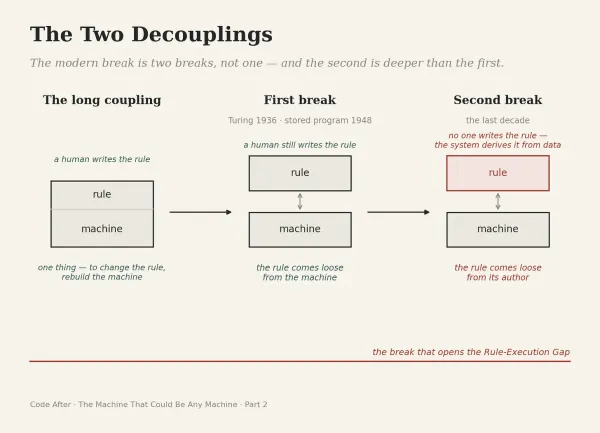
The Decoupling Part 2 of 2. In Part 1, the rule and the machine were one thing for thousands of years, and that binding kept computation governable without anyone trying. Here it comes apart — first from the substrate, then from its author — and the power concentrates in two hands. In 1936 a mathematician of twenty-three set out to answer a question about the limits of logic and ended up describing the machine on the desk. The question was whether there could be a single procedure that decided

· 7 min read
The Machine That Could Be Any Machine Part I
Richard Yan

The Machine That Could Be Any Machine Part I

AI Has Ancestors Series Jun 29 · 5 min read

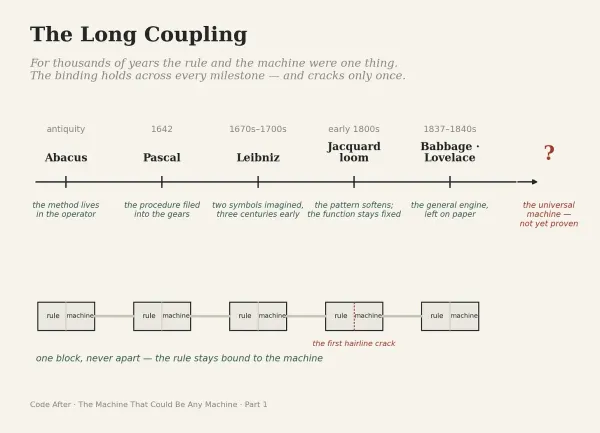
The Long Coupling The hardware companion to the language essays, in two parts. For most of history the rule and the machine were one thing — and that binding, quietly, was what kept computation governable. Part 1 is the long story of the coupling, before anyone broke it. A machine sits on a desk. It is smaller than a hardcover book, and it can become almost anything its owner asks of it: a translator, a tutor, a research assistant, a writer of working code. One object, any function. We have st

· 5 min read
The Uneven Present
Richard Yan

The Uneven Present

AI Has Ancestors Series Jun 22 · 8 min read

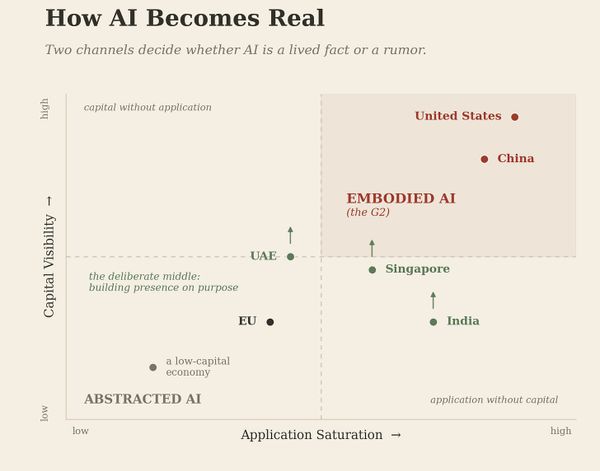
Why AI Is a Lived Fact in Some Societies and a Rumor in Others A Code After essay · companion to Code After Language AI is not one global conversation. It runs at different temperatures in different places, and the distance between hottest and coldest is wider than any single debate can hold. At one end, AI is wealth, work, and anxiety at once — met in paychecks, portfolios, and the quiet arithmetic of whether a job survives the decade. At the other, it is regulatory text and foreign headlin

· 8 min read
Part Three — The Substance
Richard Yan

Part Three — The Substance

AI Has Ancestors Series Jun 15 · 8 min read

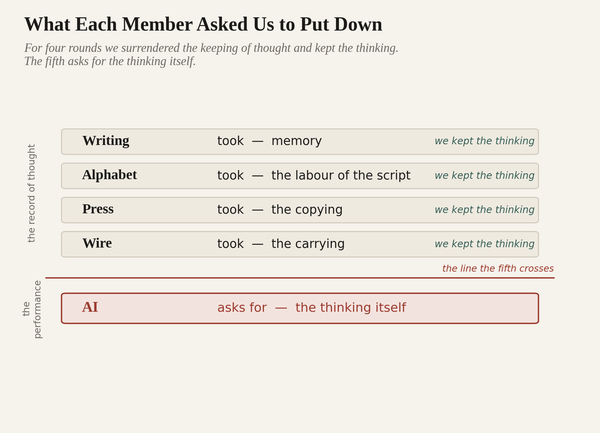
Part Three — The Substance The oldest warning in the family was aimed at the wrong technology. It was waiting for this one. A Code After essay. This is Part Three, the close of the public lead-in to Code After Language, the first paper in the Code After Series, due September 2026. Part One set out the four ancestors and the pattern they made — the Pre-Code condition, every technology that worked on the record of thought and left the thinking to us. Part Two marked the break to the

· 8 min read
Part Two — The Post-Code Break
Richard Yan

Part Two — The Post-Code Break

AI Has Ancestors Series Jun 08 · 10 min read

The fifth member crosses the line the first four never touched — and one language, alone in five thousand years, was ready for it. A Code After essay. This is Part Two of the public lead-in to Code After Language, the first paper in the Code After Series, due September 2026. Part One told the story of the four encoding technologies that came before artificial intelligence — writing, the alphabet, the printing press, and the digital wire — and the single pattern running through all of them: the

· 10 min read
Part One — The Pre-Code World
Richard Yan

Part One — The Pre-Code World

AI Has Ancestors Series Jun 01 · 16 min read

The black box has a five-thousand-year family history — and it tells us what to expect, and what to defend. A Code After essay. This is the public lead-in to Code After Language, the first paper in the Code After Series, due September 2026. Part One tells the story of the four encoding technologies that came before artificial intelligence — writing, the alphabet, the printing press, and the digital wire — and the single pattern that runs through all of them. Together they make up what the seri

· 16 min read
Appendix
Richard Yan

Appendix

Code After Announcement May 08 · 4 min read

Appendix A. Terms from V0.9 Used in This Paper Term Definition Categorical Gap (v0.9, Part II) The structural mismatch between legal categories designed for deterministic, territorial, human-driven activity and AI systems that are none of these things — producing a thinning of meaning in which legal classifications cannot attach cleanly to technical realities. G2 (v0.9, Part I) An analytical category referring to state-level AI ecosystems that meet the threshold of vertically integra

· 4 min read
X. Why This, Why Now
Richard Yan

X. Why This, Why Now

Code After Announcement May 08 · 1 min read

The AI transition is not negotiable. It is not escapable. It is not reversible on any timescale that matters to the people alive now. It will affect the countries that built the AI foundations and the nations that did not, the industries that invested early and the companies that did not, the generations that grew up with it and the generations that will inherit what it becomes. It will not wait for the institutions responsible for governing it to catch up with what it is. It will not wait for

· 1 min read
IX. The Voice
Richard Yan

IX. The Voice

Code After Announcement May 08 · 2 min read

A word on register, because the writing is itself part of the argument. Frontier scholarship has accumulated habits that often make it unreadable to readers outside its own conversation. The habits are not unreasonable. They signal disciplinary membership. They protect against overclaim. They preserve the epistemic caution the disciplines have earned through long practice. But the habits have a cost. They wall off the frontier from the readers who most need access to it, and the wall is growing

· 2 min read
VIII. The Partworks Model
Richard Yan

VIII. The Partworks Model

Code After Announcement May 08 · 3 min read

The publication model the series is adopting has a precedent worth naming. Partworks publishing — the serial release of a larger body of work in instalments, with local editions produced by regional publishers under licence — was one of the most effective mass-market knowledge-distribution architectures of the late twentieth century. Italian publishers led the international expansion. RCS Libri (Rizzoli), De Agostini, and Fratelli Fabbri Editori exported partworks titles across markets and subje

· 3 min read
VII. Publication Architecture and Bilingual Commitment
Richard Yan

VII. Publication Architecture and Bilingual Commitment

Code After Announcement May 08 · 2 min read

The publication decisions for the series follow from the constraints identified earlier. AI-era institutional change moves faster than the monograph cycle, and the readers most affected by the change cannot wait for the cycle to complete. Each paper is archived on Zenodo as the versioned record, with a persistent DOI, and disseminated through SSRN, ResearchGate, and codeafter.ai. The persistent DOI provides the scholarly record. Open access provides the reach. Version control allows the work to

· 2 min read
VI. Layered Outputs
Richard Yan

VI. Layered Outputs

Code After Announcement May 08 · 2 min read

A single register cannot serve every reader the project is built to reach. The academic reader needs citations, methodological detail, and engagement with the relevant literatures. The policymaker needs concrete implications for the decisions they face. The professional reader needs diagnosis in the domain they work in. The general reader needs access to the argument without first becoming fluent in the disciplines it draws on. Writing for all four at once produces a register that serves none of

· 2 min read
V. The Series
Richard Yan

V. The Series

Code After Announcement May 08 · 4 min read

Expert opinion on AI ranges from the age of abundance to existential collapse. Both extremes are widely held by serious people. Code After takes neither position as its starting point. The project proceeds from a different premise: AI will change people's lives and the institutions they depend on in ways that produce both gains and costs, and the analytical task is to examine, domain by domain and in real time, what is actually changing, what dangers and opportunities are emerging, and what inst

· 4 min read
IV. The Widening Gap
Richard Yan

IV. The Widening Gap

Code After Announcement May 08 · 13 min read

Every paper in the series will include an update. The interval between papers is four months. That is long enough for the AI field to move materially, and the analysis of any domain has to account for where the field is rather than where it stood when the previous paper appeared. The update is not a postscript. It is part of the method. Each paper will revisit the framework's earlier arguments, test them against intervening developments, and state openly where the analysis has held, where it req

· 13 min read
III. The Core Thesis
Richard Yan

III. The Core Thesis

Code After Announcement May 08 · 3 min read

The four gaps of v0.9 are instances of a more general pattern. They are what happens when Pre-Code instruments are required to reach Post-Code actors. The mechanism is decoupling. Three terms now carry the weight of the project. The Pre-Code condition names institutional systems built on the assumption that code operates as deterministic instrumentation, subordinate to human intention and traceable through stable chains of execution and accountability. The Post-Code condition names institutiona

· 3 min read
II. What Came Before
Richard Yan

II. What Came Before

Code After Announcement May 08 · 3 min read

Code After: Law, Accounting, and the Governance of Artificial Intelligence (v0.9, April 2026) is the foundation of the project. It is an open-access manuscript of roughly 55,000 words that diagnoses four structural gaps through which the governance of AI fails and proposes a constitutional framework designed to close them. It was released through Zenodo with a persistent DOI and is also shared through SSRN and ResearchGate. It has begun to draw responses from scholars and practitioners across la

· 3 min read
I. Why Code After
Richard Yan

I. Why Code After

Code After Announcement May 08 · 4 min read

Code After names a break. [1] For most of modern history, code meant deterministic instructions executed by tools that did what they were told. Law, accounting, regulation, the architectures of authority that hold a society together — this is the inherited apparatus of modern governance. All of it was built on the assumptions that condition made available. Humans act. Tools execute. Responsibility is traceable. The instrument disappears into the result, and the result can be audited back to the

· 4 min read
A Translation Project for the AI Era
Richard Yan

A Translation Project for the AI Era

Code After Announcement May 08 · 1 min read

Abstract This paper announces the Code After Series: six papers over twenty-four months. Each extends the framework of Code After: Law, Accounting, and the Governance of Artificial Intelligence (v0.9, April 2026) into a distinct institutional domain being reshaped by AI. The paper opens by naming the structural break the project is built to address — the move from a Pre-Code condition, in which deterministic code was executed by transparent tools, to a Post-Code condition, in which probabilisti

· 1 min read
Glossary
Richard Yan

Glossary

Code After V0.9 Apr 12 · 8 min read

Terms are listed alphabetically. Cross-references appear in italics. Part of first significant appearance noted in parentheses. Term Definition First Appearance Agentic Shift The transition from AI systems that generate predictions to systems that initiate actions — reallocating decision rights and driving governance downward into the stack. Part III AI Era The period in which AI systems shift from passive tools to autonomous actors capable of executing decisions, initiating transact

· 8 min read
Part V - The Material Constitution of the AI Era
Richard Yan

Part V - The Material Constitution of the AI Era

Code After V0.9 Apr 12 · 28 min read

Compute, Capacity, and the Constitutional Limits of Governance Part IV mapped how rules travel and who shapes their movement. Part V shifts from the linguistics of governance to its physics — from the frameworks through which rules spread to the material foundations that determine what can be built, who can build it, and how far their authority can reach. Traditional authority rests on rule primacy: whoever controls the rules controls the system. Frontier AI introduces a different structural l

· 28 min read
Part IV - The Governance Engine
Richard Yan

Part IV - The Governance Engine

Code After V0.9 Apr 12 · 38 min read

Design, Propagation, and the Incorporation Heuristic Part III mapped a world organized around three incompatible governance stacks — internally coherent, externally misaligned, and dependent on intermediaries to function across borders. Part IV turns to those intermediaries. The Translation Layer is not a metaphor. It is an institutional, legal, financial, and operational architecture through which the G3 stacks make contact — the apparatus that determines which rules travel, which are filtere

· 38 min read
Part III - The Architecture of the Global AI Stack
Richard Yan

Part III - The Architecture of the Global AI Stack

Code After V0.9 Apr 12 · 8 min read

Note Protocol Note — v0.9 Release: Part III is presented in compressed form; full-length development of each component will appear in v1.0. Part II established that law and accounting — the State’s dual governance languages — can no longer classify or measure AI with the precision their institutional authority requires. The Translation Layer has filled that gap by default. But the Translation Layer does not operate in isolation. It operates within a material structure — the AI governance stack

· 8 min read
Section II Accounting as the Language of Measurement
Richard Yan

Section II Accounting as the Language of Measurement

Code After V0.9 Apr 12 · 33 min read

Accounting is the part of the governance stack most readers never see — yet it is one of the layers that most powerfully shapes what AI becomes in practice. Section I established law as the language of authority — the system that classifies actors, assigns responsibility, and sets the boundaries of AI action. Section II turns to the second compiler: accounting, the language through which AI becomes economically real. This section is more technical than Section I because it addresses the machine

· 33 min read
Part II — THE GRAMMAR OF GOVERNANCE
Richard Yan

Part II — THE GRAMMAR OF GOVERNANCE

Code After V0.9 Apr 12 · 20 min read

Note Protocol Note — v0.9 Release: Part II integrates the material drafted as Chapters 3 and 4; the full versions arrive in v1.0. The Dual Languages of Governance The failures catalogued in Part I — of sight and of execution — share a common root: governance is a language before it is an institution. Before the State can regulate, it must classify. Before it can enforce, it must measure. Before it can hold an actor accountable, it must render that actor legible in terms its institutions can

· 20 min read
Chapter 2 The Rule-Execution Gap
Richard Yan

Chapter 2 The Rule-Execution Gap

Code After V0.9 Apr 12 · 29 min read

Why Governance Fails at Implementation, Not Legislation A government can govern only what it can see — but sight alone does not restore control. Chapter 1 identified the Visibility Gap: the structural blindness produced by opacity, fragmentation, and acceleration. Yet even perfect vision does not guarantee control. The deeper failure is execution. Consider the cockpit of an aircraft. The radar is clear; the storm ahead is unmistakable. The pilot moves the controls. The dashboard responds. Ever

· 29 min read
Chapter 1 The Structural Diagnosis
Richard Yan

Chapter 1 The Structural Diagnosis

Code After V0.9 Apr 12 · 24 min read

Part I The Structural Diagnosis Why Sovereignty No Longer Compiles: Governance after AI For much of the modern era, states governed from a position of informational advantage. Authorities assumed they could see enough of the world to classify it, regulate it, and enforce their decisions through law. That assumption no longer holds. [1] The technologies that once waited for human direction now act at machine speed. AI systems classify, allocate, negotiate, and enforce at scales that exceed

· 24 min read
Why This Book Exists
Richard Yan

Why This Book Exists

Code After V0.9 Apr 12 · 4 min read

For roughly three centuries in the Western legal‑bureaucratic tradition, sovereignty rested on a single architectural assumption: the State occupied the highest vantage point. From that altitude, it could observe territory, classify activity, and issue commands that flowed downward through the transparent medium of law. Visibility and authority were inseparable; to see was to govern. That architecture no longer holds. We have crossed the threshold from the Information Age — when computers proc

· 4 min read
About This Work
Richard Yan

About This Work

Code After V0.9 Apr 12 · 2 min read

Code After is a research programme examining how artificial intelligence reshapes the institutional structures of everyday life. Version 0.9 provides the vocabulary and methodologies for understanding AI's impact on law, accounting, and governance. The Series extends this foundation through six papers, each addressing one domain — language, education, work, evidence, measurement, and jurisdiction — and explaining how AI reorganizes the systems societies rely on to coordinate action, establish tr

· 2 min read