
We automated the machines. We never automated the space between them. That space is where the future of factory work is being decided.
I. The finishing hall
The most consequential technology decision I ever made was not a technology decision. It was a decision about leather.
We ran leather finishing in Shanghai. Finishing is the stage where a hide takes its lacquers and its pigments, where the surface becomes the thing the customer is actually paying for. That surface stays wet for a while. Whatever is in the air while it is wet lands on it and stays there.
A hide is expensive before it is finished. It is a natural material, uneven by nature, and it has already accumulated most of its cost by the time it reaches the finishing hall. Diesel exhaust in that building is not an environmental abstraction. It is particulate and odor arriving at the one point in the process where neither can be tolerated. It is rework, rejected lots, and hides downgraded to a cheaper grade. It is also the air two shifts of people breathed for eight hours at a stretch.
We moved to electric forklifts in finishing as soon as machines we could actually use became available to us. We kept diesel in the wet end, where the exhaust cost us nothing.
I want to be exact about what happened there, because it is this entire essay in miniature.
We made no decision about the future of material handling. We made a decision about the finish. Nobody in that building was asked whether industrial vehicles ought to be electrified, and nobody would have been qualified to answer. The finish decided. We complied.
Tanning is one of the oldest industries there is. We used a new technology to solve a very old problem, and the substitution was clean: same task, same pallet, same driver, different power source.
What is happening to that same machine now is not a substitution.
II. Where automation stopped
A factory is a set of islands.
Inside each island, automation has gone remarkably far. A machining center runs a shift with almost no intervention. A paint robot repeats a motion to a tolerance no hand achieves. A semiconductor tool performs a process no human could perform at all.
Then something has to move. Material comes off a trailer. A pallet goes into a rack. Components reach a cell at a particular hour. Work in progress goes to the next process. Finished goods travel to shipping and back onto a trailer.
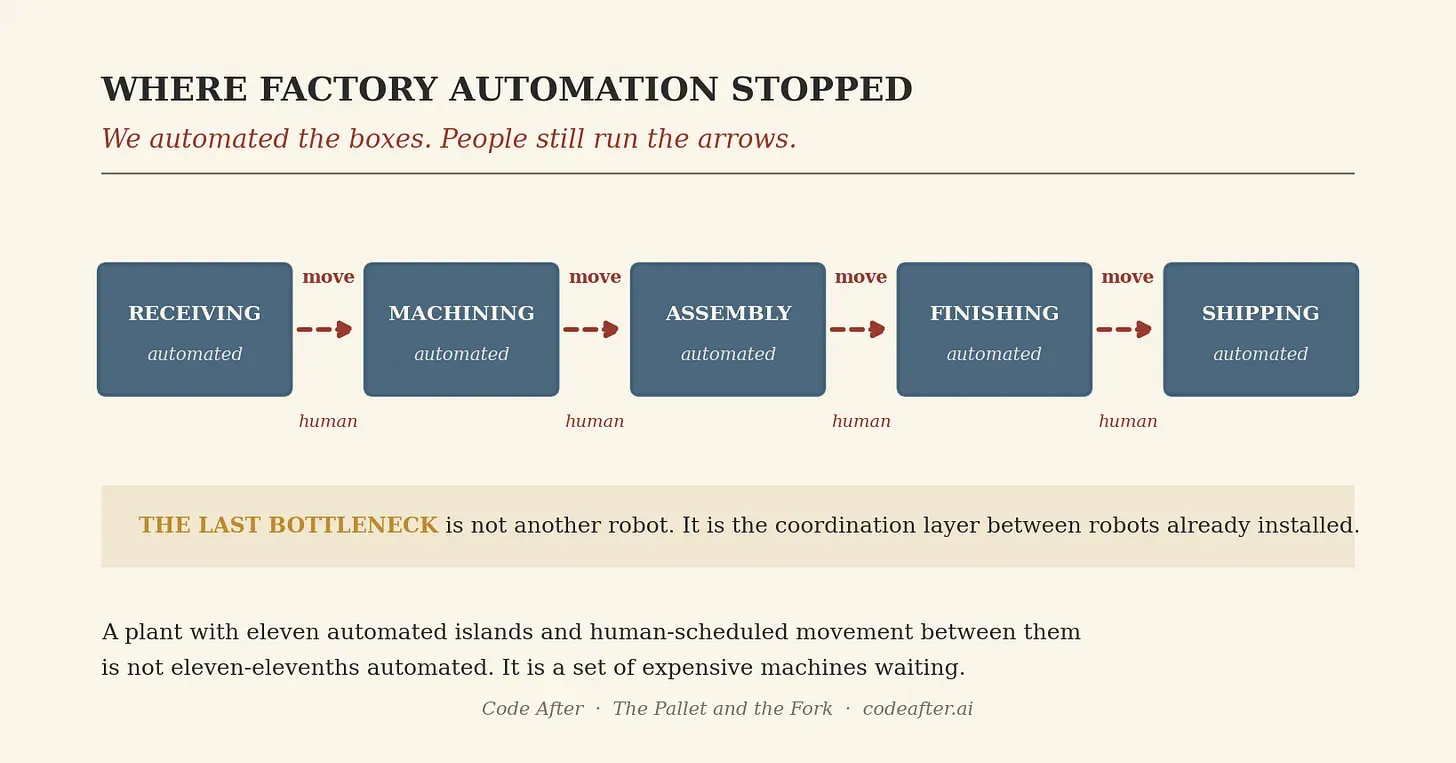
We automated transformation. We did not automate transfer.
Say it a second way, because the second way is the one that generalizes. We automated the operations. We did not automate the orchestration. Draw the factory as boxes and arrows and the point becomes plain: we have spent a century and an enormous amount of capital making each box more capable, and people still run most of the arrows.
This is usually filed as a detail of warehouse engineering. It is not a detail. It determines whether any of the rest compounds. An automated cell inside a manually fed plant produces local efficiency and system-level queueing. The bottleneck does not disappear; it moves into the aisle, where it is harder to see and nobody owns it. A plant with eleven automated islands and human-scheduled movement between them is not eleven-elevenths automated. It is a set of expensive machines waiting.
So the last bottleneck in factory automation is not another robot. It is the coordination layer between the robots already installed.
III. The pallet is already a standard
Here is what separates this problem from the rest of the physical-AI landscape, and it is the part that gets the least attention.
Factories are heterogeneous by nature. Machines come from different vendors and different decades. Software systems refuse to talk to each other. Layouts change. Schedules change. Trucks arrive late. Material ends up where nobody put it. People walk through aisles.
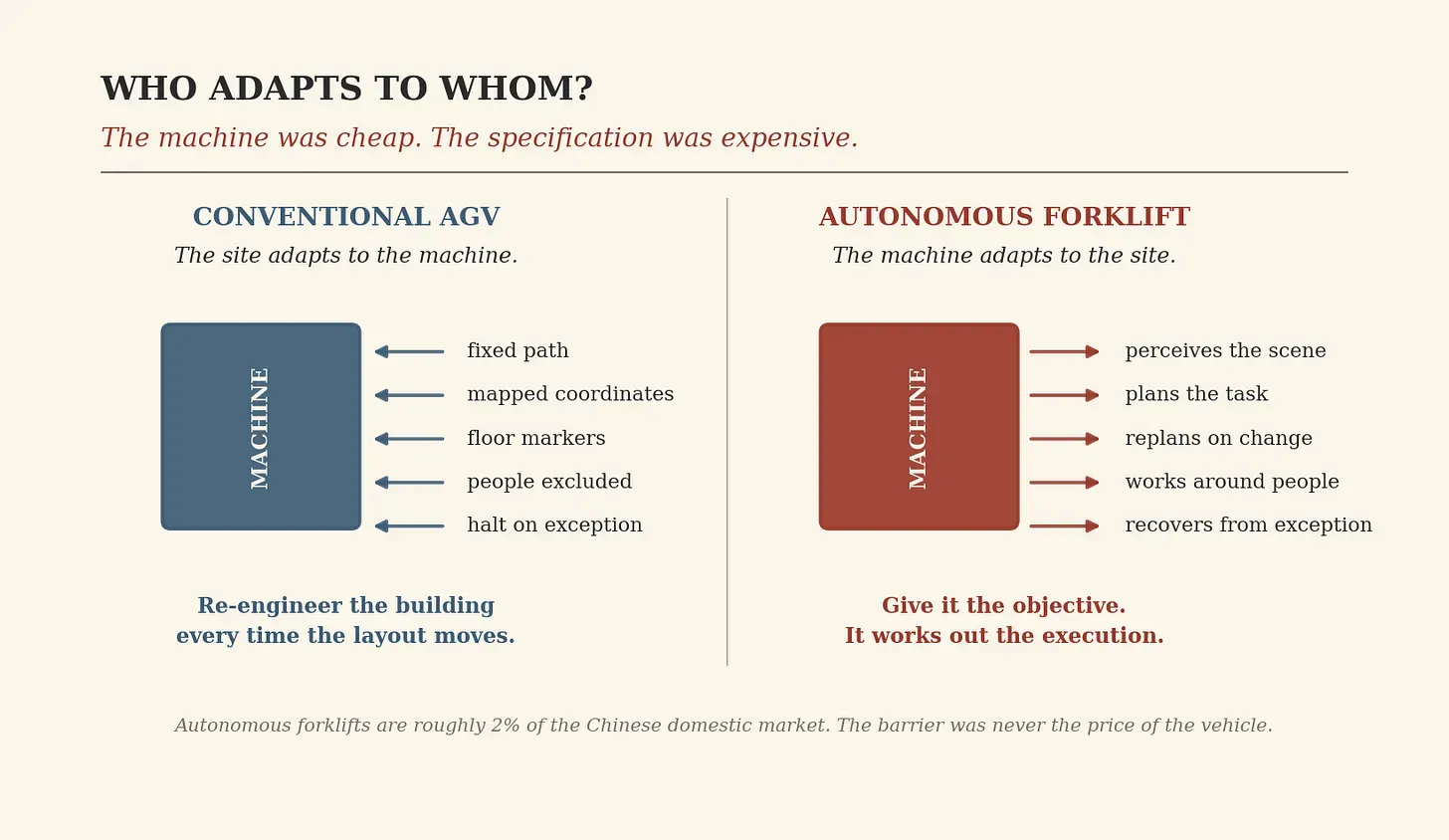
Classical automation deals with this by removing it. Build the conveyor. Fix the route. Install the reflectors and the floor markers. Specify the coordinates. Keep people out. Then tell the machine exactly what to do. In a sufficiently structured environment this works extremely well, which is precisely why it stops working when the environment moves.
The forklift sits on a different foundation. Industry standardized its physical interface generations ago, for reasons that had nothing to do with autonomy. Forks fit pallets. Pallets fit racks. Racks fit buildings. Trailers accept pallets. A production cell receives them. The pallet is a unit of material that the rest of the building has already agreed to address.
The comparison worth drawing is the shipping container, and it needs to be drawn carefully. The container did not make ports intelligent. It made cargo addressable, and everything else reorganized itself around the addressable unit over the following thirty years: cranes, chassis, hulls, terminals, insurance, customs paperwork. The standard came first. The system followed.
Inside the factory, that standardization already happened. What was missing was a machine that could perceive the standard rather than be told where it was.
Put in the terms this project keeps returning to: the pallet made material addressable. It never made material legible to anything other than a person. A human driver supplied the perception. Remove the driver and the abstraction collapses, which is why it has held for eighty years and why closing the last gap changes the value of everything built on top of it.
IV. The constraint was never the price of the machine
Autonomous forklifts are not new. They have existed for decades. Their price has fallen substantially. Adoption has stayed small.
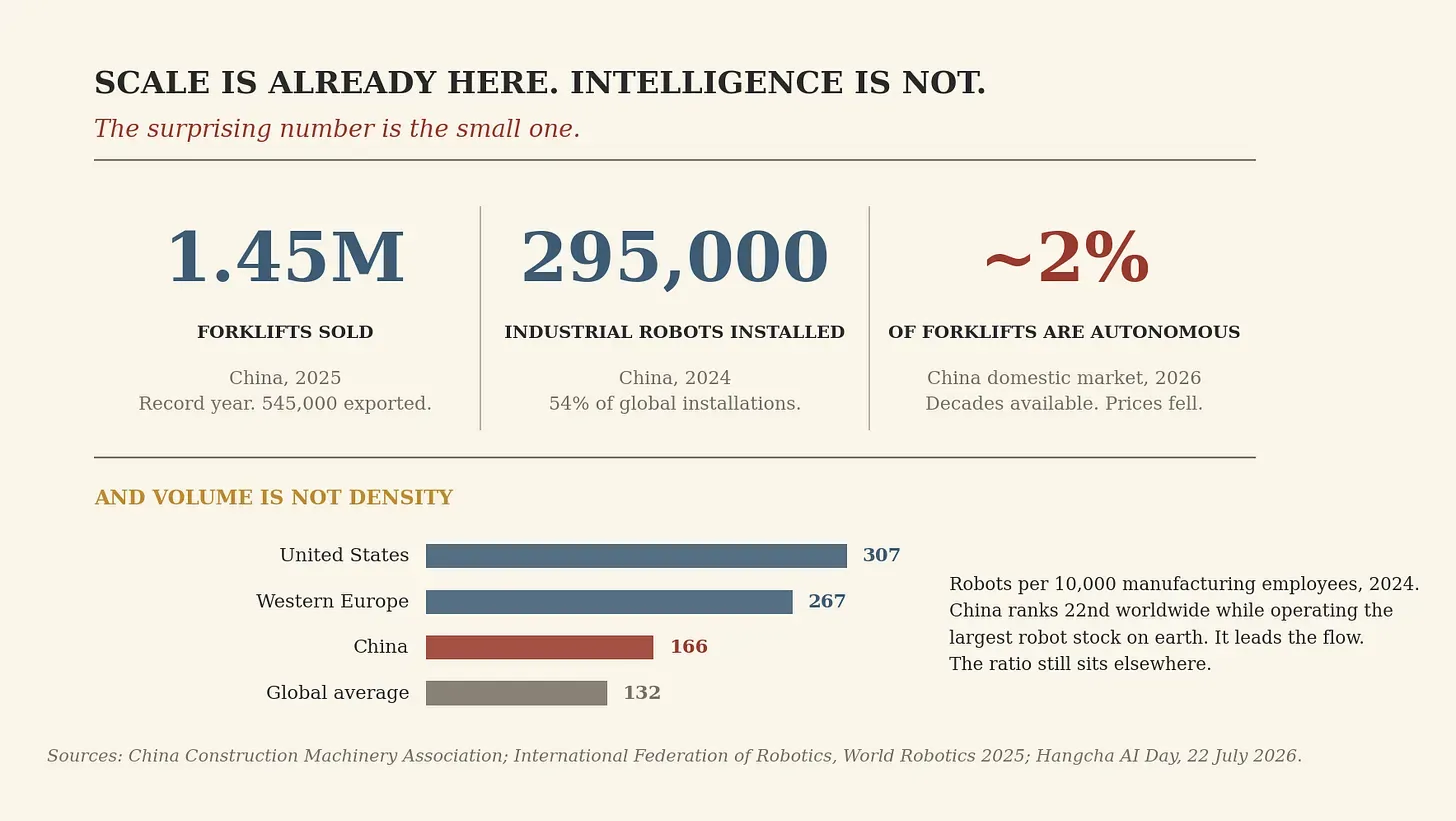
Hangcha, one of the two large Chinese manufacturers, put the number publicly at its first AI Day on July 22, 2026: autonomous forklifts account for around two percent of forklifts in the Chinese domestic market. Independent industry counts put 2025 autonomous unit sales above twenty-five thousand, against Chinese forklift sales of 1.45 million that year. Two counts, two denominators, one order of magnitude.
The company’s diagnosis of why is more useful than the number. Wenfei Wang, Hangcha’s chief technology officer, drew the line at the level of instruction rather than the level of hardware: a conventional automated guided vehicle follows the exact path it is given, while an autonomous forklift is handed a task and works out the execution itself. What is being replaced, on that account, is not the operator’s hands but the decision chain behind them.
Read that as a cost statement rather than a technical one. Every conventional deployment required mapping the building, configuring coordinates, integrating with warehouse and control systems, and repeating a meaningful fraction of that engineering whenever the physical environment changed. Which it does, constantly, in any plant that is actually producing.
The machine was cheap. The specification was expensive.
That is the real barrier, and it explains why falling prices on the vehicle itself never produced adoption. You were not buying a forklift. You were buying a forklift plus a commitment to hold the building still.
V. What physical AI changes
The distinction between a prescribed machine and an intelligent one sounds like marketing. It is not.
A prescribed machine executes a representation that a person built for it in advance. A physical-AI system does something categorically different — it builds that representation itself, revises it as conditions change, selects an action, and registers when the world failed to respond the way it predicted. That last capacity is the one that carries the economics.
This is where the relationship to language models becomes concrete rather than rhetorical. Language models reason over symbols. That is a genuine capability and it is genuinely new, and it comes with no account of weight, friction, momentum, or geometry. A model that has read every warehouse manual ever written still has no representation of whether these particular forks will enter that particular pallet, whether the load is centered, whether it stays stable through the turn, whether a carton has shifted since the last observation, or whether the action about to be taken leaves the world in a safe state.
World models supply the missing term. They give the system a predicted next state against which to check the action. Planning and consequence, in the same loop.
The architectures are still competing and nobody should call the outcome. Some developers separate high-level embodied reasoning from a vision-language-action model that executes. Others build explicit world models and simulate outcomes before acting. Hangcha’s published stack pairs a foundation model built for industrial vehicles with 3D lidar and multi-camera vision, split across a cloud-and-edge engine. These are different bets. Treating any one of them as settled is a mistake, and the factory owner has no reason to care which name wins.
What is stable is the direction of travel: from execute the path toward pursue the objective and account for the result.
The owner’s version of that test is a sentence. Move everything Line 3 needs for tonight’s production, do not interrupt the people working there, and keep the outbound dock clear for the truck arriving at six. If a machine can convert that objective into safe physical action under conditions nobody specified in advance, the economic regime has changed, whatever the taxonomy ends up calling it.
For a forklift, the difference is unusually large, because a forklift is not a vehicle passing through the world. It is a machine that rearranges the world. It picks things up. It changes where they are. It changes what becomes visible. It changes the mass it carries and therefore its own dynamics. Every move it makes alters what the next machine is able to do.
Which is why the value should not be measured against the driver. A hundred-thousand-dollar machine that replaces one operator is a labor-substitution story worth exactly one wage. The same machine raising utilization across twenty million dollars of production equipment is a capital-productivity story. A fleet that then permits inventory, layout, scheduling, and production planning to be redesigned is a factory-architecture story. The orders of magnitude are in the third one.
VI. China’s position, stated accurately
The Chinese forklift story is usually told as a second Chinese EV story. The analogy is a useful entry point and a misleading explanation.
The industrial facts are not in dispute. On China Construction Machinery Association counts, Chinese manufacturers sold 1,285,500 forklifts in 2024 and exported 480,514 of them to 193 countries; 2025 set records on both lines, with sales near 1.45 million and exports of 545,000. Electric machines were 73.6 percent of 2024 sales and 78.8 percent of exports. China has been the world’s largest producer and consumer of forklifts for sixteen consecutive years. On International Federation of Robotics figures, China installed 295,000 industrial robots in 2024, 54 percent of global installations, and passed two million robots in operational stock.
Three corrections to the popular version.
China did not electrify the European forklift fleet. It entered a market that had already gone substantially electric for reasons of indoor air quality, regulation, and running cost. Those are the same reasons that emptied our finishing hall of diesel. What China’s battery supply chain changed was which electric architecture won, as lithium displaced lead-acid. That is a real advantage and a smaller claim than the one usually made.
Export penetration is not brand share, and volume is not density. Chinese manufacturers lead on units and lag on revenue. Toyota, KION, and Jungheinrich hold installed bases, service organizations, certification records, and customer relationships built over decades, and they are working the same problem. On robot density the IFR puts China at 166 robots per ten thousand manufacturing employees in 2024, twenty-second in the world, against 307 for the United States and 267 across Western Europe. That figure rests on revised labor-force data from China’s own National Bureau of Statistics and sits well below estimates published in earlier years, which is worth knowing before anyone reaches for the older number. China installs more than half the world’s new robots and operates the largest stock on earth. The ratio still sits elsewhere. This contest is open.
And the data flywheel is not automatic. China’s first forklift advantage was supply. The contest now moving into view is over the learning environment, and that is a different asset: an unusual density of physical edge cases occurring in commercial operation, in buildings that already contain the machines. Intelligence of this kind lands where the data surface already exists. It does not land where the ambition is loudest. That is a statement about where capability accumulates, not a prediction about who wins, and the distance between those two statements is where most commentary goes wrong.
VII. Nobody has priced the exception
Turning the forklift into a learning node opens a question that arrives before the technology question is settled.
Industrial data is not internet data. What a machine observes on a factory floor discloses production volumes, layouts, yields, process sequences, cycle times, and, by inference, customers and margins. A supplier that captures an exception at one customer’s plant, trains on it, and deploys the improved behavior at that customer’s competitor has taken something real. It was never priced in the purchase order. It appears in no line of the contract. It has no owner in the accounts of either party.
The same structure shows up on the liability side. A prescribed vehicle has a specification. When it injures someone, the questions are whether it followed the path and whether the path was safe. Both are testable, and machinery certification, product liability, and workplace safety law are built on the assumption that they are. A machine that constructs its own representation and selects its own action carries no path to test it against. The conformity regime inspects compliance with a specification the machine no longer holds.
Neither question will stop the economic pressure to deploy. Both will be answered after deployment, in the order that pressure permits, and they will open one plant at a time in an industry that files no press releases.
That is a whole argument of its own, and this essay is not the place to spend it.
VIII. The tool closes the option
Bill Gates published six thousand words on this last month, under the title “The turbulent AI era is here. The choices we make now are critical.” His strongest move is to refuse the comfortable version: he argues that AI and robotics reach past white-collar work into physical work, that capable robots could be competing for physical tasks in construction and hospitality by the end of the decade, and that no plan exists for the transition. Then he names two instruments. Tax AI and robots as payroll is taxed, to slow the substitution away from human labor. And set aside categories of work for people only, a domain he calls Human Reserved.
Take the diagnosis seriously and look at where the instruments attach. Both aim at a moment of decision: a firm choosing between a person and a machine, a legislature choosing which tasks stay human. That is the right place to aim if the decision is made there.
Inside a factory, it is not made there.
Follow what happens when mobile material handling stops requiring the plant to accommodate it. Deployment engineering falls away. The cost of moving a pallet resets. The plants that reset first do not announce it. They quote.
The price the customer now expects was set somewhere else, by someone who already moved. At that point the plant manager holds no automation decision at all. He does not choose the machine. He receives the price the machine has already set.
This is the part I have been circling for a long time. In any competitive industry, the space of viable strategies is bounded by the available toolset. When the toolset moves, strategies leave the feasible set without anyone voting them out. The board that approves the capital expenditure two years later is not making a choice. It is ratifying a foreclosure that happened upstream, in someone else’s plant, when a cost curve crossed.
That inverts the usual sequence. We assume capability is developed, management evaluates it, governance sets terms, and adoption follows. What happens is that capability is deployed, competitive pricing propagates it, adoption becomes compulsory, and governance arrives to find the question already answered.
Which is not an argument against Gates’s instruments. It is an argument about their timing. A robot tax and a reserved category are both attempts to price a decision, and they work only while the decision still exists. That interval is the entire space in which anyone gets to choose anything.
Nobody in our finishing hall chose. We were told by the finish.
IX. The count is right. The denominator is wrong.
Here is the consequence that belongs in a governance argument rather than a trade publication, and it requires conceding something first.
The Bureau of Labor Statistics counts 792,500 industrial truck and tractor operators in the United States in 2024, at a median wage of $46,390. It projects the occupation to reach 801,600 by 2034. That is growth of one percent against a three percent average across all occupations, and the Handbook gives the reason in its own words: demand, it says, may be limited by the expansion of automated machinery and sensing technology.
So the instrument is not asleep. It sees the machine and it has already marked the occupation down. The popular version of this argument, in which official statistics sit blandly in a protected column while robotics arrives unannounced, is not true here. It is worth saying so before extending the argument, because the extension is the part that holds.
What an occupational projection cannot do is change its own unit of analysis. It asks how many operators a factory of the current design will need. It holds the workflow fixed and varies the technology inside it. Physical AI varies the workflow.
Look at where these workers actually are: 36 percent in warehousing and storage, 12 percent in wholesale trade, 6 percent in food manufacturing, 3 percent in construction. This is a building-to-building occupation before it is a factory occupation, and the buildings differ. That cuts against a purely factory-shaped argument, and it also concentrates the exposure, because warehousing is where the coordination problem is simplest and the case for intelligent movement lands first.
Then note that the operator is the visible line, and the smallest one. Behind him sits an apparatus that exists because material movement has to be planned by people. Schedulers. Expediters. Inventory planners. Receiving clerks. Production planners. Shift supervisors. The Monday morning meeting where a plant reconciles what it intended to build against what it can actually feed. None of these is a material-moving occupation. Every one of them is a coordination job, and coordination jobs are what an intelligent movement layer displaces first, because they were created by the absence of one.
The instrument counts occupations. The change is to architecture. An occupational projection has no line for a job that stops existing because the reason for it stopped existing.
We have watched this exact sequence before. The productivity gain from the electric motor did not arrive when a motor replaced a steam engine while the line shafts and belts stayed where they were. It arrived decades later, when factories were rebuilt around distributed power: a motor on each machine, machines arranged by process instead of by proximity to a driveshaft, buildings that no longer had to be tall to keep the belts short. The technology came first. The reorganization delivered the gain, and the reorganization is what rewrote the job.
It also lands differently from white-collar displacement in ways that matter politically. Exposure here is geographically concentrated, physically visible, organized, and attached to particular buildings in particular towns. When a distribution center changes its staffing model, a county notices. When a professional services firm quietly stops hiring analysts, nobody notices for three years.
X. Watch the less glamorous vehicle
Chinese electric cars deserve the attention they get. They show what happens when a technological reset meets an industrial system capable of building the new architecture faster and cheaper than the incumbents.
But passenger cars compete inside transportation. The forklift sits inside production. Its first transition came from batteries, and it changed the cost structure of the machine. Its second transition is larger, because it changes what the machine is. Once perception, embodied reasoning, and fleet coordination let mobile material handling adapt to plants instead of forcing plants to adapt to it, the forklift stops being a vehicle and becomes part of the factory’s control system.
We have spent several years asking when AI will learn to operate a machine. The more consequential manufacturing question is when it learns to operate between the machines. The answer will arrive on a pair of forks, in a building nobody writes about, and it will arrive as a price quote rather than an announcement.
I got the diesel forklifts out of that finishing hall because they were ruining the leather. It was a substitution: one power source for another, the task untouched. What comes next is not a substitution. It connects the factory’s islands into something that can perceive and coordinate itself, and a factory that can coordinate itself is a different factory, with a different capital structure, a different layout, and a different set of reasons to employ people.
So the labor question is the second question. The first one is the one I would put to any operator reading this.
We keep asking which workers a factory will replace. The prior question is how many jobs exist because the factory cannot coordinate itself.
Join the discussion
Become a member of Code After AI to start commenting.
Sign up now