
The Long Coupling
The hardware companion to the language essays, in two parts. For most of history the rule and the machine were one thing — and that binding, quietly, was what kept computation governable. Part 1 is the long story of the coupling, before anyone broke it.
A machine sits on a desk. It is smaller than a hardcover book, and it can become almost anything its owner asks of it: a translator, a tutor, a research assistant, a writer of working code. One object, any function. We have stopped finding this strange. We should start again, because the thing on the desk is the end of a story that took most of human history to tell, and it is not the story we are usually told.
The story we are usually told is about speed. Each year the chips get faster, the models get larger, the curve bends upward, and the future arrives ahead of schedule. That story is true and it explains almost nothing, because it begins in the middle. It takes the strangest fact about the machine on the desk and treats it as obvious: that a single object can be directed to do things its maker never anticipated, simply by changing what is written into it.
This essay tells the older story. For almost all of human history, the rule and the machine were the same thing. A device did exactly what its physical form encoded and nothing else. You could not change what it computed without rebuilding it. The machine was the procedure, cast in wood or brass. This binding of rule to substrate is not a quaint feature of old machines. It was the condition that kept computation governable for thousands of years, and it is the condition we have just left behind.
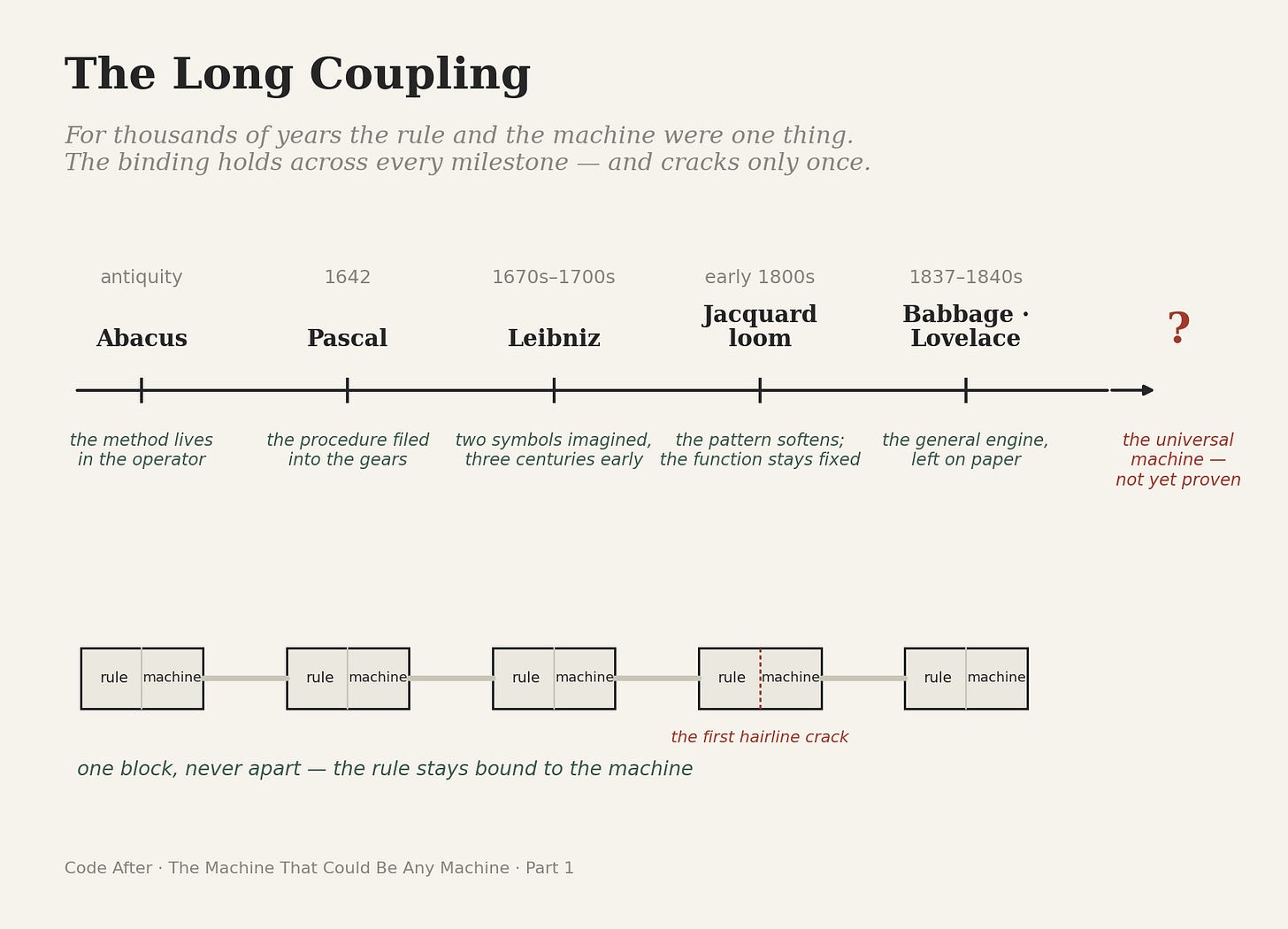
Begin where computation begins, with a frame of beads. The abacus is thousands of years old in one form or another, and for most of that span, in most of the world, it was the best calculating instrument anyone had. What it teaches is easy to miss. The abacus holds a number; it does not hold a method. The method lives in the operator, in a human trained for years to move beads in disciplined sequence. The device and the person together formed the computer, and neither half could be reprogrammed. To compute something new, you trained a new operator or built a new instrument. The software, if we can call it that, ran on people. The hardware only kept the count.
Brass changed where the procedure lived, not how tightly it was held. In 1642 a nineteen-year-old built a geared machine to spare his father, a tax official, the labor of adding columns by hand. Pascal’s calculator could add and subtract, because addition and subtraction were the shapes filed into its gears.
A generation later Leibniz extended the idea to a machine that could also multiply and divide, and then reached past his own century, imagining in separate writings that every number could be expressed with only two symbols. The dream outran the brass. His machine, like Pascal’s, did one fixed class of thing. The instruction was the mechanism, and to ask a different question you built a different mechanism. It would take three hundred years for the two-symbol idea to find a substrate that needed it.
The first crack in the binding came not from a calculator but from a loom. In the first years of the nineteenth century a weaving machine, perfected by a Lyon silk-weaver from attempts others had abandoned, read its pattern from a chain of punched cards. The figure in the cloth was no longer built into the loom. It was written on the cards, and the loom obeyed whatever the cards instructed. Change the cards and the same machine wove a different design.
This is the moment the instruction came apart from the mechanism that carried it out, and everything that follows grows from it. The separation was still partial. The loom could only weave; its function stayed fixed even as its pattern went soft. But for the first time a machine did what it was told rather than only what it was, and what it was told could be rewritten without touching the machine.
One man saw the cards and saw further than cloth. Charles Babbage spent the back half of his life designing an engine that would take the loom’s principle to its conclusion: a machine with a store to hold numbers, a mill to work on them, and a reader for punched cards that would direct the work step by step, including steps that depended on the results of earlier ones. He called it the Analytical Engine. It was not a calculator for a single task. It was a general engine that could be aimed at many, the same iron directed to different ends by different cards.
The clearest account of what this meant came from Ada Lovelace, who understood that a machine able to manipulate symbols by rule was not confined to numbers at all. If the relations of pitched sound could be written as symbols, she observed, the engine could in principle compose music. The generality was the whole point, and she described it before any machine existed to demonstrate it.
No machine existed, and in their lifetimes none would. The Analytical Engine was never built. The retrospective explanation is that the Victorian workshop could not deliver thousands of gears to the precision the design demanded. The explanation closer to the truth is that the institutions gave way before the workshop was ever tested. The British government had sunk a fortune into Babbage’s earlier calculating engine and watched the work stall when his master machinist walked off over payment; it declined to fund the new design at all. The metal was never given the chance to fail. The idea was complete; the support that any large machine needs in order to enter the world was not. Even in 1840, the fate of computation turned on institutions, and that fact is about to matter more than anyone then could see.
Stand back from the whole sequence and one shape holds across all of it. The bead frame, the brass calculators, the punched-card loom, the engine that stayed on paper: in every case the rule was bound to the substrate, or the instruction was tied to a single fixed function, and computation stayed slow, local, and scaled to the hand. Slow enough that the institutions built to govern counting and recording and calculation kept pace without effort. The clerk, the ledger, the law of contract, the audit: none of them strained against the abacus or the Pascaline, because none of those machines could get ahead of the people who used them.
Call this the Pre-Code condition: the long span in which the rule and the machine that ran it could not come apart, and computation, for that reason, could not outrun the people and institutions that governed it. No one drafted rules for the governance of computation, because computation could not get ahead of anyone. The binding was the silent precondition of governability, and it held so quietly that no one thought to name it until it was gone. It is the same condition the companion essay describes for language, seen from the other side: for most of history the software of civilization ran on human beings, and the machines only helped.
One move had not been made. Across every page of this history, nobody had proven that a single machine, given the right instructions, could become any machine at all. The proof, when it came, would not come from an engineer building a better engine. It would come from a mathematician asking a question that had nothing to do with machines, and the answer would take the binding apart for good. What came after is a different condition entirely.
Join the discussion
Become a member of Code After AI to start commenting.
Sign up now